

Collection by designer Ludwig Mies van der Rohe - Buro International
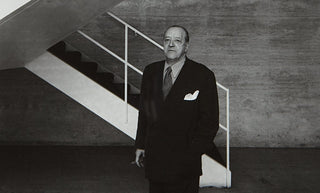
Designer
Ludwig Mies van der Rohe
Collection by Ludwig Mies van der Rohe


Configurable


Configurable


Configurable
Get expert advice in one of our physical showrooms
Family business with 40+ years of experience in office and complete interior fit-out.
4.8/5 Excellent ★★★★★ based on 100+ reviews
Get expert advice in one of our physical showrooms
Family business with 40+ years of experience in office and complete interior fit-out.
4.8/5 Excellent ★★★★★ based on 100+ reviews
Designer
Ludwig Mies van der Rohe (1886-1969) was a German-American architect, academic and interior designer, often referred to simply as Mies. He is regarded as one of the pioneers of modern architecture. In the 1930s, Mies was the last director of the Bauhaus, a groundbreaking school of modernist art, design and architecture. After the rise of Nazism and its strong opposition to modernism, Mies emigrated to the United States. There he became head of the school of architecture at the Illinois Institute of Technology.
Mies sought to establish his own distinctive architectural style that would embody modernity. His buildings used modern materials, such as industrial steel and glass, to define interior spaces. He is often associated with his fondness for the aphorisms "less is more" and "God is in the details."
Mies was born in Aachen, Germany, in 1886 and began his career in his father's stonemasonry business and at various local design firms before moving to Berlin. There he joined the office of interior designer Bruno Paul. He began his architectural career as an apprentice in the studio of Peter Behrens from 1908 to 1912, where he was exposed to the design trends of the time and progressive German culture. He worked alongside Le Corbusier and Walter Gropius, who was later also involved in the development of the Bauhaus. Mies served as construction manager of the German embassy in Saint Petersburg under Behrens.
Mies changed his name as part of his transformation from the son of a tradesman into an architect working with Berlin's cultural elite. He added "van der" to his name, using the Dutch "van der" because the German form "von" was legally restricted to the German nobility. He began his independent professional career designing houses for the upper class.
After the First World War, while still designing traditional neoclassical houses, Mies embarked on a parallel experimental path. He joined his avant-garde colleagues in the long-running search for a new style suited to the modern industrial age. Since the mid-19th century, progressive thinkers had criticised the weaknesses of traditional styles, mainly because of the contradictions of hiding modern building technology behind a facade of ornate traditional styles.
After the First World War, Mies began groundbreaking projects and grew into an architect who created forms in harmony with the spirit of the emerging modern society. He boldly abandoned all forms of ornament and made a dramatic modernist debut in 1921 with his striking design proposal for the faceted, all-glass Friedrichstraße skyscraper, followed in 1922 by a taller, curved version called the Glass Skyscraper.
Mies and Le Corbusier later acknowledged the lasting influence of Frank Lloyd Wright's Wasmuth Portfolio after it was exhibited in Berlin. This collection of his work had a considerable impact on the development of modernism in architecture.
Through his bold vision and innovative designs, Mies van der Rohe left an indelible mark on modern architecture and design, and his legacy remains a source of inspiration for future generations.
Why choose Buro International:
Family business with 40+ years of experience in office and complete interior fit-out
On request, we assemble your furniture on site
Come and get inspired and discuss your ideas with our advisors